
Can You Take Photos at the Alhambra?
If you’re visiting the Alhambra, you’ll probably want to take photos. But what are the rules for photography at the Alhambra?
Between the intricate Islamic carvings, the symmetry of the Courtyard of the Lions, and the sweeping views over Granada, it’s one of the most photogenic places in Spain.
The good news is that you are allowed to take photos inside the Alhambra. The slightly more complicated news is that there are rules you need to respect, especially inside the Nasrid Palaces. If you understand those rules before you arrive, you won’t run into any problems.
Is photography actually allowed inside the Alhambra?
Yes, it is. As a regular visitor, you can take photos throughout most of the complex for personal use. That includes the Generalife gardens, the Alcazaba, the Palace of Charles V and, importantly, the Nasrid Palaces themselves.
The key distinction is personal versus commercial use. If you’re simply capturing memories of your visit, you’re fine. The Alhambra receives millions of visitors each year and photography is a normal part of that experience. Staff are not trying to stop people from taking pictures. What they are trying to prevent is damage, congestion and professional activity without permission. As long as you behave like a visitor and not like a production crew, you’ll have no issues.
If photos are important to you, timing also matters. Our guide to the best time of day to visit the Alhambra can help you choose better light and a calmer pace.
Why flash photography is not allowed
One of the most important restrictions concerns flash. Inside the Alhambra, flash photography is prohibited. This isn’t an arbitrary rule. The Nasrid Palaces in particular contain delicate plasterwork, centuries-old painted wood and intricate decorative surfaces that are sensitive to repeated light exposure. Even though a single flash might not seem harmful, the cumulative effect of thousands of flashes per day can be damaging over time. That’s why staff are strict about it.
Before you enter interior areas, it’s worth checking your phone or camera settings. In darker rooms, automatic flash can switch on without you noticing. If you accidentally use it once, you’ll probably receive a polite reminder. Repeated use, however, may lead to staff intervening more firmly.
Can you bring a tripod or professional equipment?
This is where many visitors get surprised. Tripods are not allowed inside the Alhambra. The reason has less to do with photography itself and more to do with space. The Nasrid Palaces are narrow, visitor flow is continuous and entry is timed. A tripod in that environment quickly becomes an obstacle.
You’re also not allowed to set up lighting equipment or large stabilizers. Even monopods are typically discouraged. If you show up with bulky equipment, you may be asked to store it before entering sensitive areas.
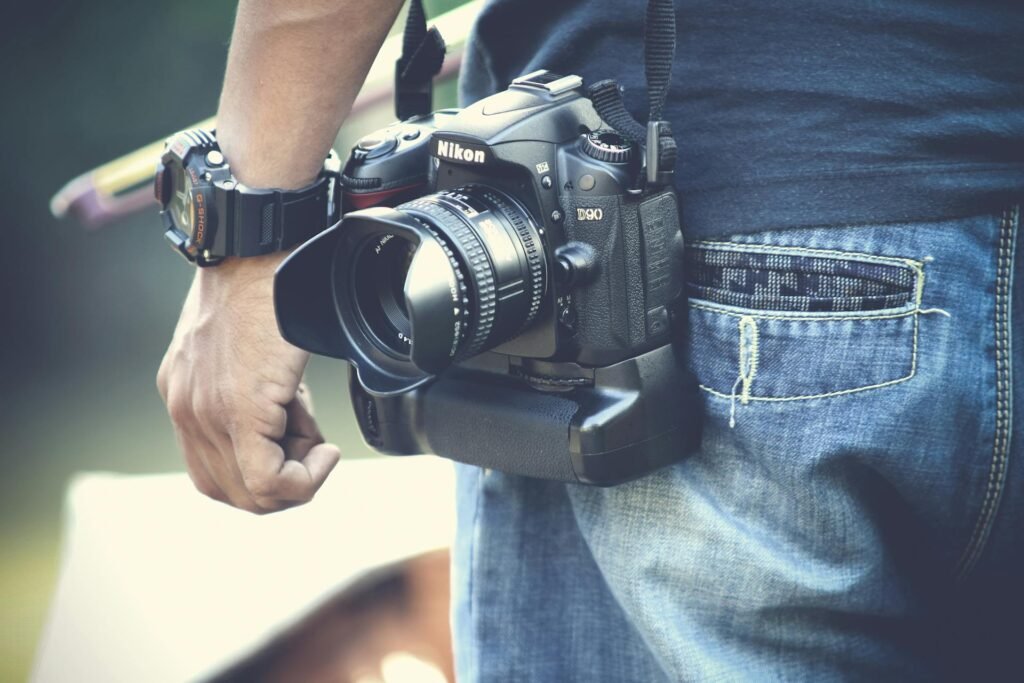
That said, you are allowed to bring a proper camera. A digital single-lens reflex camera or mirrorless camera is not a problem in itself. The staff do not ban “professional-looking” cameras; they ban professional setups. There is a difference. If you’re holding a camera and taking photos like any other visitor, you’re fine. If you’re directing people, staging shots or unpacking accessories, it starts to look like commercial activity.
What about filming video?
Casual video recording is generally allowed, provided it is clearly for personal use. Short clips on your phone or a small handheld camera are normal and common. The Alhambra understands that visitors want to capture the atmosphere.
However, once filming becomes structured or equipment-heavy, you move into a different category. Interviews, scripted content, influencer-style productions with gear or anything that resembles commercial work requires official authorization.
If you’re unsure whether your setup is “too much,” ask yourself whether it would attract attention in a crowded historic monument. If the answer is yes, it’s probably better to keep things simple.
Want more practical tips for your visit? See our Alhambra Visitor Guide. For short answers to common visitor questions, you can also check the Alhambra frequently asked questions.